BUYER'S GUIDE · EDUCATION

Which microscope should my school buy?

Updated · Labo America product team
THE SHORT ANSWER

For middle and high school biology, buy a durable compound microscope such as the CxL, plus a stereo microscope such as the Luxeo 2S for whole specimens. For college and pre-clinical courses, step up to the Lx 300 with Plan Achromat objectives. For stereo zoom in biology labs, choose the Luxeo 4Z.

OUR PICKS

Which LABOMED® model fits which practice.

If you areChooseWhy
Middle and high school, stereoLuxeo 2SSingle cast construction, LED transmitted and incident light, 1x and 3x.
Biology lab, stereo zoomLuxeo 4Z4.4:1 zoom from 8x to 35x with LED transmitted and incident light.
Middle and high school, compoundCxLAluminum stand with brass gears, Semi-Plan Achromatic 4x to 100x, LED rated up to 50,000 hours.
College and pre-clinicalLx 300Plan Achromat 4x to 100x, LED rated to 50,000 hours, adjustable height head.

Compound or stereo microscope for the classroom?

A compound microscope magnifies thin, transparent specimens on slides, such as cells and tissue, from about 40x to 1000x. A stereo microscope gives a lower power, three dimensional view of whole objects such as insects, leaves and rocks, with room to work underneath. Most science programs need both. The CxL and Lx 300 are compound. The Luxeo 2S and Luxeo 4Z are stereo.

Monocular or binocular microscopes for students?

Monocular heads are simpler and cost less for younger students. Binocular heads reduce eye strain over a full lab period and help students who struggle to close one eye. The CxL is offered with monocular, binocular and trinocular heads, so you can mix them across a classroom.

Do classroom microscopes need oil immersion (100x)?

Only if students will look at bacteria or blood cells in detail. For younger classes a 3 objective set avoids oil entirely. The CxL comes with 4 objectives (4x, 10x, 40x, 100x oil) or 3 objectives (4x, 10x, 40x).

Why do classroom microscopes use LED illumination?

LED stays cool, uses little power and lasts much longer, which matters when microscopes are shared by many classes. Every LABOMED® classroom microscope uses LED. The CxL and Lx 300 are rated up to 50,000 hours of LED life.

What does Plan, Semi-Plan and Achromatic mean on an objective?

Achromatic objectives correct color for two wavelengths. Plan objectives also flatten the field so the whole view is in focus at once, not just the center. Semi-Plan is in between. The CxL uses Semi-Plan Achromatic objectives. The Lx 300 uses Plan Achromat objectives for college work.

How do I show the whole class what is under the microscope?

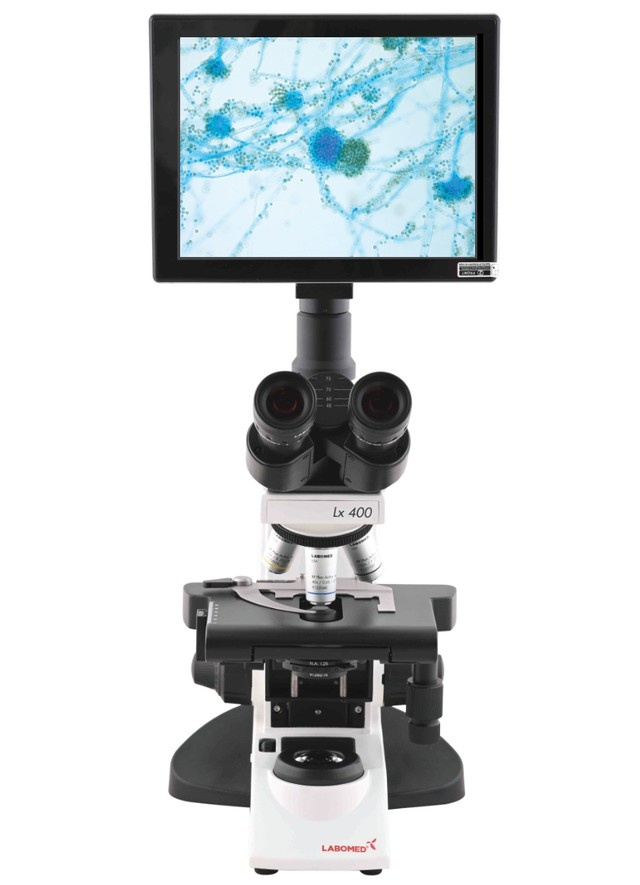
Add a camera to a trinocular head and send the image to a screen. The iVu Touch is a camera with its own touchscreen. The Vega connects over HDMI to a monitor or projector. The Vega 4K adds 4K resolution and Wi-Fi.

How durable are LABOMED® classroom microscopes and what is the warranty?

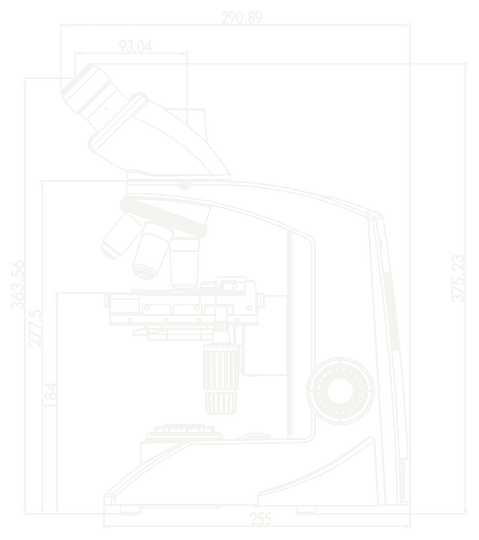
The CxL uses a single mold aluminum stand with brass rack and pinion stage drive, and the Luxeo 2S uses single cast construction with an all metal gear focus system. LABOMED® life sciences products carry 5 years on parts and labor, 2 years on cameras and 1 year on electrical parts.

Lx 300 or Lx 400 for a college lab?

Both accept phase contrast, dark field and polarizing kits. Choose the Lx 300 for teaching labs that need Plan Achromat optics and LED light at a classroom price. Choose the Lx 400 for a wider 10x/20 field, a 200 x 140 mm stage, the Köhler illumination attachment and the LED fluorescence attachment.

AT A GLANCE

Key specifications compared.

From the current LABOMED product records. Confirm configuration specific values with Labo America.

SpecificationLuxeo 2SLuxeo 4ZCxLLx 300
Magnification2 step changer: 1x, 3x; 10x to 30x or 20x to 40x totalZoom 4.4:1: 8x to 35x total40x to 1000x total (10x eyepieces, 4x to 100x objectives)40x to 1000x total (10x eyepieces, 4x to 100x objectives)
ObjectiveGreenough optics, 2-step 1x/3x (10x/30x total)Greenough zoom pod, 4.4:1; optional 1.5x auxiliary objective with riser blockLP series DIN Semi-Plan Achromatic objectives 4x, 10x, 40x (spring loaded), 100x (spring loaded, oil), antifungalEP2 Plan Achromat DIN Infinity objectives 4x, 10x, 40x (spring loaded), 100x (spring loaded, oil), antifungal
Working distance100 mm100 mm4x: 16.5 mm, 10x: 6.45 mm, 40x: 0.45 mm, 100x oil: 0.10 mm4x: 6.20 mm, 10x: 4.32 mm, 40x: 0.45 mm, 100x oil: 0.10 mm
Field of view6.0 to 18 mm or 4.5 to 9 mm6.6 to 28.5 mmFN 18 mm (10x/18 eyepieces)FN 18 mm (10x/18 eyepieces)
Light sourceLED, incident and transmittedLED, incident and transmittedLED, rechargeable battery, variable intensityLED, rechargeable Li-ion battery, variable intensity
Viewing headBinocular, 45° inclinedBinocular, 45° inclined; trinocular version available45° inclined, 360° captive rotationSiedentopf binocular (butterfly), 45° inclined, 360° rotatable, viewing height adjustable up to 40 mm; or Siedentopf trinocular, 30° fixed
StandFixed integrated stand, single-cast construction (no stand options)Fixed integrated stand, single-cast construction (no stand options)Single mold aluminum die-cast with ergonomic handrests for enhanced comfort and stability.Single mold sturdy stand with anti-rust materials. Ergonomic base for hand rest and greater stability.
Camera optionsNot applicableTrinocular head; C-mount adapter 0.50x; Vega 6MP, Vega 4K, Atlas+ 4K, iVu Touch camerasTrinocular head; CxL C-mount adapters 0.35x/0.50x; Vega 6MP, Vega 4K, Atlas+ 4K, iVu Touch cameras30° fixed trinocular head; C-mount adapters 0.35x/0.50x/0.65x; Vega 6MP, Vega 4K, Atlas+ 4K, iVu Touch cameras
Contact us